
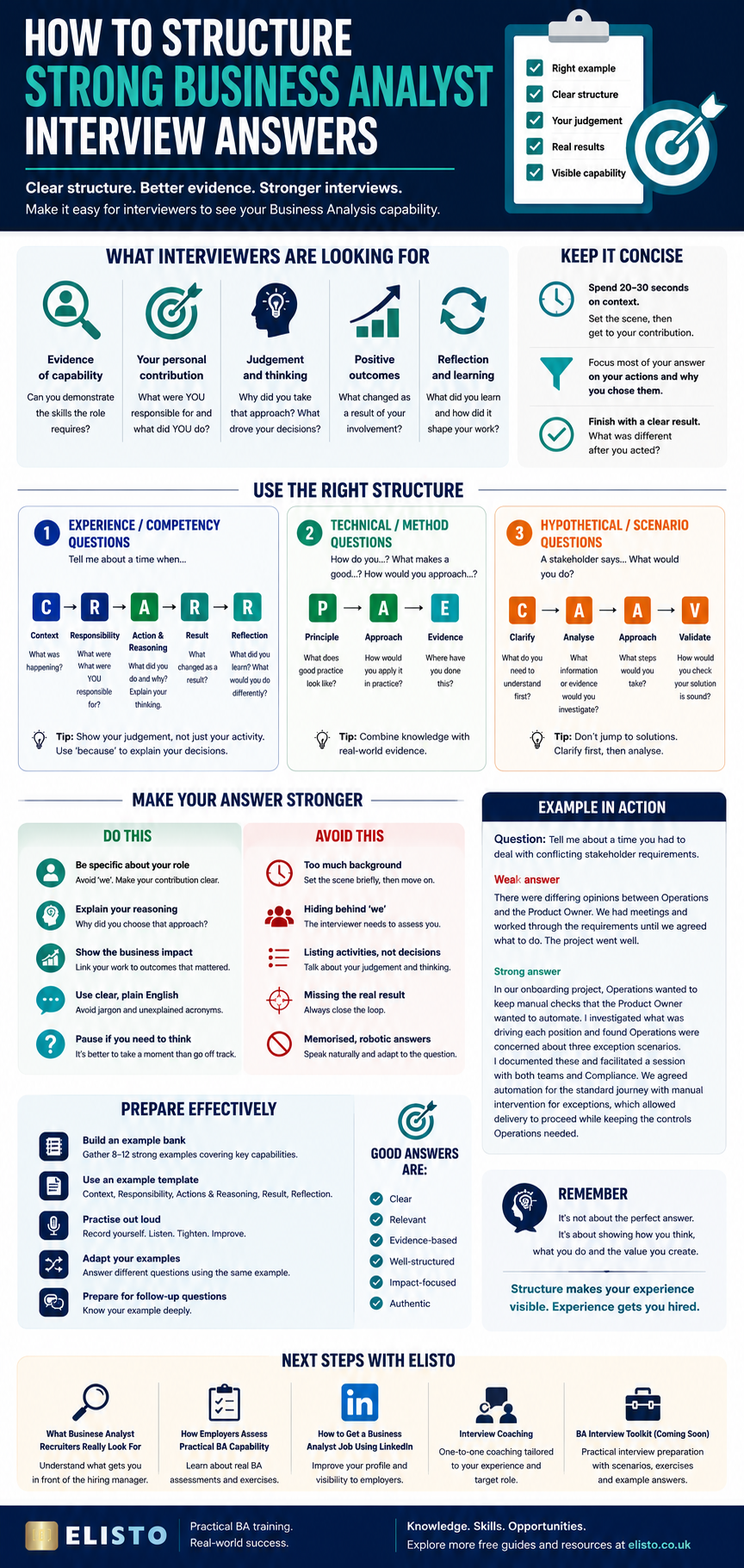
How to Structure Strong Business Analyst Interview Answers
Written by Jude Mahoney
Agile Delivery Lead | Business Analyst Mentor | 20 Years Experience
LinkedIn: Jude Mahoney
You can have twenty years of Business Analysis experience, an excellent CV and exactly the skills an employer needs, and still give a poor interview answer.
The problem is often not a lack of experience. It is failing to make that experience easy for the interviewer to assess. (I've been there...).
Ask a candidate about conflicting stakeholder requirements and they may spend three minutes explaining the project before reaching what they personally did. Ask how they improved a process and they might describe every workshop, meeting and document they produced without ever explaining what actually improved. Others go the opposite way and give a perfectly tidy textbook answer with no evidence that they have ever done it themselves.
A strong Business Analyst interview answer needs to do something much simpler: show the interviewer what happened, what you were responsible for, what you did, why you did it and what changed as a result.
Structure helps you do that.
It does not mean memorising speeches or forcing every question into STAR. The aim is to organise your experience so that your Business Analysis capability, particularly your judgement, becomes visible.
What is the interviewer actually trying to hear?
Consider this question:
“Tell me about a time you had to deal with conflicting stakeholder requirements.”
The interviewer is not asking for an entertaining story about difficult stakeholders.
They are looking for evidence.
Did you recognise the conflict? Did you understand what was driving it? Did you distinguish genuine business needs from preferred solutions? Did you challenge appropriately? Did you facilitate a decision? Did you understand the consequences of the available options?
Perhaps most importantly:
What did you actually do?
This is why good structure matters. The interviewer should not have to excavate the evidence from your answer.
The same principle applies throughout the recruitment process. Your CV and LinkedIn profile initially provide evidence that you might be suitable for the role. As we explain in Elisto's guide to What Business Analyst Recruiters Really Look For, that evidence can help get you in front of the hiring manager.
The interview is where the employer starts testing it.
STAR is useful, but it isn't the answer to everything
One of the best-known structures for answering competency questions is STAR:
Situation → Task → Action → Result
The National Careers Service recommends STAR as a way of keeping interview examples short and relevant while showing skills and experience. It also advises candidates to make their examples conversational rather than overly rehearsed and to prepare for follow-up questions. (National Careers Service)
There is good reason for its popularity.
It gives an answer a beginning, middle and end.
But STAR can become a problem when candidates treat it as a script.
You do not need to say:
“The Situation was…”
“My Task was…”
“The Action I took was…”
“The Result was…”
The interviewer does not need to hear the framework.
They need to hear the evidence.
A better Business Analyst version might sound something like this:
“I was working on a digital onboarding project where Operations wanted to retain mandatory manual checks while the Product Owner wanted to automate the entire journey. I was responsible for establishing what was genuinely required before the team committed to a solution.
“I spoke to both groups separately first because I wanted to understand what was driving their positions. It became clear that Operations weren't actually opposed to automation; they were concerned about three exception scenarios. I documented those scenarios and then facilitated a session with Operations, Product and Compliance to work through each one.
“We agreed that the standard journey could be automated while retaining manual intervention for the exceptions. That gave the delivery team an agreed set of requirements and allowed the automated journey to proceed without removing the controls Operations needed.”
That is essentially STAR.
But it sounds like somebody explaining how they worked, rather than somebody completing an interview formula.
Keep the Situation short
This is one of the easiest ways to improve an interview answer.
You understand the background to your example because you lived through it. The interviewer didn't.
That creates a temptation to explain everything.
The programme started two years earlier. There were five delivery teams. The original Product Owner left. Operations used an old system. Finance had another system. Then a new Programme Director arrived...
Several minutes can disappear before you reach the part that answers the question.
The Situation exists to make the rest of the answer understandable.
Nothing more.
For example:
“I was the BA on a project replacing a manual customer-onboarding process. Operations and Compliance disagreed about which checks could safely be automated.”
That's probably enough.
What should you do?
Take your strongest interview examples and practise explaining the context of each in around 20–30 seconds.
Ask:
What is the minimum the interviewer needs to know for this example to make sense?
Keep that.
Remove the rest.
Make your personal responsibility obvious
Business Analysts rarely work alone.
You may work alongside Product Owners, Delivery Managers, Project Managers, developers, testers, architects, UX professionals, subject-matter experts and other analysts.
That creates another interview problem:
“We held a workshop…”
“We decided…”
“We spoke to the stakeholders…”
“We agreed…”
Who is we?
The interviewer is assessing you.
That does not mean claiming credit for other people's work. It means making your contribution clear.
Compare:
“We needed to understand the existing process.”
with:
“I was responsible for establishing the AS-IS process and identifying where the delays were occurring.”
The second gives the interviewer something they can assess.
Prospects' guidance on competency interviews makes a similar point: acknowledge teamwork where appropriate, but make your individual contribution clear. (Prospects)
What should you do?
For every example you prepare, be able to answer one question:
What was I personally responsible for?
If you cannot explain that clearly, the example probably needs more work.
Spend most of the answer on your actions
This is where the strongest evidence usually sits.
What did you actually do?
For a Business Analyst, that might include interviewing stakeholders, analysing data, mapping a process, facilitating workshops, reviewing existing requirements, observing users, challenging assumptions, defining requirements, evaluating options, prioritising work or supporting testing.
But listing activities is not enough.
Compare:
“I held workshops, created process maps and gathered requirements.”
with:
“Operations and Finance were describing the process differently, so I interviewed them separately before bringing them together. I mapped both versions of the AS-IS process and found an undocumented Finance approval that was creating much of the delay.”
The second answer tells us something about how that BA thinks.
There was conflicting information.
They recognised it.
They chose an appropriate way to investigate it.
Their analysis revealed something useful.
That is evidence of capability.
The most valuable word in your answer may be “because”
This is where Business Analyst interview answers can become considerably stronger.
Don't just explain what you did.
Explain why.
“I interviewed the stakeholders separately because I suspected the group setting was preventing one team from challenging the other.”
“I observed the process because the documented procedure didn't match what users were describing.”
“I challenged the proposed solution because nobody had demonstrated that it addressed the underlying problem.”
“I split the user story because it contained several independently valuable behaviours and was too large to develop and test sensibly.”
Those explanations expose your judgement.
An employer can teach somebody where a particular button sits in Jira.
It is considerably harder to teach sound analytical judgement.
What should you do?
When preparing an interview example, repeatedly ask:
Why did I do that?
Why a workshop?
Why individual interviews?
Why process mapping?
Why did you challenge the requirement?
Why did you involve that stakeholder?
Why did you recommend that option?
Why did you prioritise one requirement above another?
If you can explain those decisions convincingly, you stop sounding like somebody who merely knows BA techniques and start sounding like somebody who understands how to apply them.
Finish properly: what was the result?
This is where otherwise strong answers sometimes simply fade away.
“So we completed the workshop and everyone was happy.”
That is not much of a result.
What changed?
Perhaps the team gained an agreed set of requirements. Perhaps an unnecessary stage was removed. Perhaps an expensive proposed solution was rejected. Perhaps the organisation avoided regulatory risk. Perhaps processing time fell. Perhaps a release could proceed.
Where genuine figures exist, use them.
If processing time fell from five days to two, that is useful evidence.
If you don't know the figure, don't invent one simply because you've been told interview answers need measurable results.
A perfectly legitimate outcome might be:
“The analysis demonstrated that we didn't need to replace the entire system. We could address the immediate problem by changing two stages of the process, which substantially reduced the scope of the project.”
That still demonstrates value.
What should you do?
Ask:
What was different after my involvement?
That question often reveals the result more clearly than asking yourself whether you have an impressive metric.
Go beyond STAR: add reflection
There is a useful extension to STAR:
STARR — Situation, Task, Action, Result, Reflection.
Prospects recommends the additional reflection stage as an opportunity to explain what you learnt and how the experience subsequently shaped your behaviour. (Prospects)
For Business Analysts, this can be particularly valuable.
Suppose you're asked:
“Tell me about a time something didn't go to plan.”
A weak answer tries to disguise success as failure.
“I suppose sometimes I'm too thorough…”
Avoid that sort of thing.
A stronger candidate can discuss a genuine mistake without making themselves sound incompetent.
For example:
“Looking back, I involved the operational users too late. I'd spent too much time working through requirements with management and assumed their description accurately reflected how the process worked. When we eventually validated it with users, we discovered several workarounds that changed the requirements.
“Since then, I've made a point of involving the people actually performing a process much earlier in discovery.”
That is a useful answer.
Something went wrong.
The BA recognised why.
They learnt from it.
Their subsequent behaviour changed.
Reflection demonstrates maturity.
Don't force technical questions into STAR
Not every Business Analyst interview question is asking for a historical example.
You may be asked:
“How do you approach requirements elicitation?”
“What makes a good user story?”
“How would you prioritise requirements?”
“How do you know when a requirement is ready for development?”
Trying to force these questions into Situation → Task → Action → Result can produce an awkward answer.
For technical or methodology questions, a better structure is:
Principle → Approach → Evidence
Principle: demonstrate that you understand the underlying concept.
Approach: explain how you would apply it.
Evidence: briefly demonstrate where you have actually done it.
For example:
“I wouldn't choose an elicitation technique until I understood the problem, the stakeholders and what information we needed. Different techniques reveal different things.
“I'd normally review whatever evidence already exists, establish who holds the relevant knowledge and then choose techniques accordingly. Interviews can be useful for detailed individual knowledge, observation where the documented and actual processes may differ, and workshops where we need collective understanding or decisions.
“On one transformation programme, for example, the documented process differed substantially from what Operations were actually doing, so observation and individual interviews were much more valuable initially than starting with a large workshop.”
That answer demonstrates:
knowledge → application → experience.
Much stronger than reciting a textbook definition of requirements elicitation.
Structure hypothetical questions differently again
Then there are questions such as:
“A stakeholder tells you they need a new CRM. How would you approach it?”
There is no historical example to describe.
The interviewer is testing how you think.
A useful structure is:
Clarify → Analyse → Approach → Validate
Clarify: What problem is the stakeholder actually trying to solve?
Analyse: What evidence and information do you need?
Approach: What would you do to investigate and progress it?
Validate: How would you establish that your understanding and recommendation are sound?
A strong BA should be wary of accepting “we need a new CRM” as the requirement.
That is already a proposed solution.
You might begin:
“Before discussing a replacement CRM, I'd want to understand what problem the stakeholder believes the current system is causing. I'd establish who is affected, what the current process looks like, what evidence exists and what successful improvement would look like.”
Notice what hasn't happened.
You haven't started designing a CRM.
That's the point.
Sometimes the strongest answer begins with a question
If the interviewer gives you an ambiguous scenario, you do not have to pretend that you possess information they haven't provided.
Ask.
“When you say the current process isn't working, do we know what specifically is failing?”
or:
“Before I answer that, can I clarify whether the requirement has come directly from users or is currently an assumption from the business?”
That isn't avoiding the question.
It may demonstrate precisely the analytical behaviour the interviewer is trying to uncover.
The National Careers Service explicitly advises candidates to ask for a question to be repeated or explained if they do not understand it, rather than simply attempting an answer based on uncertainty. (National Careers Service)
This becomes even more important during practical assessments. As we explain in How Employers Assess Practical Business Analyst Capability, an employer may deliberately give you incomplete requirements, an ambiguous business problem or a live case study to see whether you recognise what is missing.
[Internal link: How Employers Assess Practical Business Analyst Capability]
Answer the question they actually asked
You have prepared a brilliant example about a difficult stakeholder.
The interviewer asks:
“Tell me about a time you challenged a senior stakeholder.”
You hear “stakeholder”.
Off you go.
Three minutes later, you've demonstrated conflict resolution, negotiation and facilitation.
But you never challenged anybody.
It was a good story.
It was the wrong answer.
What should you do?
Listen for the capability being tested.
If necessary, take a few seconds.
There is nothing wrong with saying:
“Yes — give me a moment to think of the strongest example.”
Then choose the evidence that actually answers the question.
A short pause is considerably better than three minutes of confident irrelevance.
Prepare examples, not scripts
This is one of the most important differences between genuine interview preparation and memorising model answers.
Don't write twenty perfect speeches and attempt to remember them.
The interviewer is unlikely to phrase the question exactly as you expected.
Instead, build an evidence bank.
You might prepare examples covering:
- conflicting stakeholders;
- difficult requirements;
- process improvement;
- challenging an assumption or proposed solution;
- prioritisation;
- Agile delivery;
- working with developers/testers;
- something that went wrong;
- influencing a decision;
- using data to investigate a problem;
- working with ambiguity;
- a significant successful outcome.
One experience may support several questions.
A project involving conflicting stakeholders might also demonstrate communication, facilitation, requirements analysis, negotiation and influencing.
The important thing is to change the emphasis depending on the question.
Prospects similarly recommends preparing a selection of examples that can be adapted across competencies rather than attempting to improvise everything during the interview. (Prospects)
Build a one-page interview evidence sheet
You don't need a 40-page preparation document.
For each strong example, record:
Context: one or two lines.
Responsibility: what you personally needed to achieve.
Actions: three to five important things you did.
Reasoning: why you chose those actions.
Result: what changed.
Reflection: what you learnt, where relevant.
Capabilities demonstrated: requirements, stakeholder management, process analysis, prioritisation and so on.
This is a memory prompt.
It isn't something to read aloud during the interview.
For an online interview, discreet notes can be useful, but don't turn them into a script. National Careers Service guidance on video interviews suggests prompt cards can be helpful while also recommending practice, clear speech and preparation of examples in advance. (National Careers Service)
Practise speaking, not just thinking
An answer that feels concise in your head can become surprisingly long when spoken.
Practise aloud.
Better still, record yourself.
Listen back and ask:
- How long did I spend on background?
- Is my personal contribution clear?
- Do I repeatedly say “we”?
- Did I explain why I made important decisions?
- Did I answer the actual question?
- Is there a clear result?
- Did I use jargon the interviewer might not understand?
- Did I repeat myself?
- Could I remove 30 seconds without losing any useful evidence?
This can be uncomfortable the first time.
It is also remarkably effective.
How long should a strong answer be?
There is no universal time limit.
A straightforward technical question may need less than a minute. A substantial competency question may require two or three minutes before the interviewer starts probing.
The better measure is:
Have I given enough evidence to answer the question without burying that evidence in unnecessary detail?
Five uninterrupted minutes is usually a warning sign.
Twenty seconds for every question may indicate the opposite problem.
Strong interview answers leave room for conversation.
Remember that the interviewer can ask:
“What happened next?”
“Why did you choose that approach?”
“How did the stakeholder respond?”
“What would you do differently?”
You don't need to force every detail into your first response.
Don't be afraid of follow-up questions
Follow-up questions aren't necessarily evidence that your answer failed.
Often they're a good sign.
Something you've said has given the interviewer an avenue worth exploring.
The important thing is that you know your example deeply enough to answer naturally.
This is another reason fabricated or heavily embellished examples are dangerous. A rehearsed fiction may survive the opening question.
It becomes considerably harder when an experienced BA or hiring manager starts asking:
“Why?”
“Who decided that?”
“How did you validate it?”
“What did the developer say?”
“What would have happened if that requirement hadn't been delivered?”
Prepare genuine evidence.
Don't drown the answer in BA terminology
You are not awarded additional points for every acronym.
BPMN, MoSCoW, INVEST, RACI, UML, SIPOC and dozens of other frameworks and techniques can be useful.
But naming them does not demonstrate that you know how to use them.
Compare:
“I used MoSCoW prioritisation.”
with:
“The stakeholders had initially classified almost every requirement as essential, so I facilitated a prioritisation session around business value, regulatory necessity, dependencies and what genuinely had to be present for the first release.”
The second tells the interviewer considerably more.
The technique matters less than the thinking behind its use.
Show commercial awareness in your answers
Business Analysis doesn't exist to produce requirements documents.
Organisations employ Business Analysts because they are trying to achieve something.
Increase revenue.
Reduce costs.
Improve customer experience.
Meet a regulatory obligation.
Reduce risk.
Replace obsolete technology.
Improve efficiency.
Launch a new service.
Your answers become stronger when you connect your analysis to the underlying business objective.
Instead of:
“I produced the requirements for the new process.”
consider:
“The objective was to reduce the manual processing that was creating a three-day backlog, so I focused the analysis on the stages responsible for the delay rather than attempting to redesign the entire service.”
Now the interviewer can see that you understood why the work mattered.
Answer at the level of the role
A Junior BA and a Lead BA might both be asked:
“Tell me about a difficult stakeholder.”
But strong answers should look different.
A more senior candidate should generally be able to draw upon examples involving greater ambiguity, complexity, ownership, organisational impact and influence.
If you're applying for a Lead BA role but every example revolves around being told to write a user story, you're not demonstrating the level at which you're applying.
For senior positions, consider examples involving:
- shaping an analytical approach;
- influencing senior stakeholders;
- coordinating analysis across teams;
- complex organisational problems;
- challenging strategic assumptions;
- coaching or leading other analysts;
- resolving significant conflicts;
- making or influencing difficult trade-offs.
What should you do?
Before choosing examples, ask:
What does good performance at this level actually look like?
Then select evidence accordingly.
What if you're trying to become a BA and don't have formal BA examples?
Don't invent them.
A career changer may already have excellent transferable examples.
Perhaps you've investigated recurring customer complaints, improved an operational process, analysed data, worked with a technology team, gathered information from colleagues, supported testing or helped implement change.
Those experiences can demonstrate analytical capability even if your job title wasn't Business Analyst.
The challenge is recognising and articulating them.
For example:
“I dealt with customer complaints.”
doesn't reveal much.
But perhaps what actually happened was:
“I analysed recurring complaints and found that most were being generated by the same stage of the customer process. I mapped the issue with Operations and worked with the systems team to define a change.”
That's potentially useful BA evidence.
Be accurate about your role.
Then explain its relevance.
Elisto's Business Analyst Career Transition Assessment is designed to help people considering a move into Business Analysis think about how convincingly their existing experience translates into BA capability.
[Elisto link: Take the Business Analyst Career Transition Assessment]
Weak, good and strong answers can contain the same experience
This is worth understanding.
Imagine the candidate genuinely improved a broken order-management process.
Weak
“There were some problems with the process, so we held workshops and I created an AS-IS and TO-BE process map. We then implemented the new process and it went well.”
There may be a good example hiding in there.
But we cannot see much of it.
Better
“I was asked to investigate why customer orders were regularly being delayed. I mapped the AS-IS process with Operations and found that orders were being manually checked twice by different teams. I worked with both teams to agree a revised process that removed the duplicate check, which reduced delays.”
Much clearer.
Stronger
“I was asked to investigate recurring order delays. Management initially believed the problem was staff capacity, but before recommending additional resource I wanted to understand where the time was actually being lost.
“I mapped the AS-IS process with the people performing it and compared that with the documented procedure. That exposed an undocumented second manual check being carried out by another team. I validated why the check existed and established that it duplicated an existing control rather than satisfying a separate requirement.
“I then facilitated agreement between the teams to remove the duplication and updated the process and requirements accordingly. That addressed the delay without the additional headcount originally being considered.”
Same broad experience.
But the stronger answer reveals problem definition, investigation, challenge, validation, stakeholder work, judgement and commercial value.
That's what structure can expose.
What weak Business Analyst interview answers tend to have in common
They aren't necessarily factually wrong.
They are often simply difficult to assess.
Watch for:
- too much background;
- unclear personal responsibility;
- excessive use of “we”;
- listing techniques without explaining why they were used;
- textbook definitions without practical evidence;
- no clear result;
- answering a related question rather than the actual one;
- unexplained jargon;
- invented metrics;
- memorised speeches;
- examples below the seniority of the vacancy;
- blaming stakeholders or colleagues;
- talking for several minutes without reaching a conclusion.
The solution isn't to become robotic.
It is to become clearer.
Three structures worth remembering
You don't need a framework for every possible interview question.
These three will take you a long way.
When you're asked about something you've done
Context → Responsibility → Action & Reasoning → Result → Reflection
What was happening?
What were you responsible for?
What did you do, and why?
What changed?
What did you learn?
When you're asked about your BA knowledge or approach
Principle → Approach → Evidence
What does good practice look like?
How would you apply it?
Where have you demonstrated it?
When you're given an unfamiliar scenario
Clarify → Analyse → Approach → Validate
What do you need to understand?
What information or evidence would you investigate?
How would you approach the problem?
How would you validate your conclusion?
Don't recite these labels in the interview.
Use them to organise your thinking.
What should you do before your next Business Analyst interview?
Don't spend the evening before the interview searching for another list of 100 questions.
Go back to the vacancy.
Identify the capabilities the employer is actually buying.
Then prepare perhaps eight to twelve genuine examples from your experience that collectively demonstrate those capabilities.
For each one, establish:
Context. Responsibility. Actions. Reasoning. Result. Reflection.
Practise explaining them aloud.
Shorten the background.
Strengthen your personal contribution.
Ask yourself why you made each important analytical decision.
Make the business outcome clear.
Then practise changing the emphasis of the same example to answer different questions.
Finally, prepare for the possibility that talking about your experience won't be enough. Employers can also assess BA capability through case studies, process exercises, requirements reviews, shared-screen user-story exercises and data tasks.
Read How Employers Assess Practical Business Analyst Capability next if you want to understand what those exercises can look like.
A strong answer makes your capability visible
Interview structure is not about turning yourself into a rehearsed candidate.
It should do the opposite.
Good structure removes the clutter surrounding your experience and allows the interviewer to see what is actually there.
Keep the context concise. Make your personal responsibility unmistakable. Spend most of your time explaining what you did. Explain why you made important decisions. Close the loop with a genuine result and, where useful, show what you learnt.
Use STAR or STARR for experience questions, but don't force them onto everything. Use Principle → Approach → Evidence when discussing BA methods. Use Clarify → Analyse → Approach → Validate when somebody gives you an unfamiliar scenario.
Above all, prepare evidence rather than speeches.
The interviewer shouldn't finish your answer thinking:
“They know the STAR technique.”
They should be thinking:
“I understand how this person approaches Business Analysis, and I can see evidence that they know what they're doing.”
That is the point.

Preparing for a Business Analyst interview?
Getting the interview means somebody has already seen enough potential in your experience to want to know more. The next job is converting that opportunity into an offer.
Elisto provides practical Business Analyst training and career support built around real BA work rather than theory alone. Our Knowledge Hub includes free guidance on what BA recruiters look for, how employers assess practical BA capability, career development and moving into Business Analysis.
For candidates who want more personalised support, Elisto Business Analyst Interview Coaching provides one-to-one preparation focused on the actual vacancy, your experience and how effectively you're communicating your evidence.
And we're developing more structured practical interview preparation around realistic Business Analyst scenarios and assessments — because reading about good interview technique is useful, but eventually you need to practise doing it.
Understand the question. Choose the right evidence. Explain your reasoning. Make the result clear.
Then give the interviewer enough evidence to believe you can do the job.

Share:
How to Position Yourself as a Business Analyst
Requirements Gathering & Analysis: A Practical BA Guide