
What Do Recruiters Really Look for in a Business Analyst?
Written by Jude Mahoney
Agile Delivery Lead | Business Analyst Mentor | 20 Years Experience
LinkedIn: Jude Mahoney
A recruiter does not need to decide that you are the best Business Analyst for the job.
At least, not yet they don’t.
Their first decision is simpler: is there enough evidence here for me to put this person in front of the hiring manager?
That distinction can explain why capable Business Analysts can struggle to secure interviews while apparently less experienced candidates make the shortlist. Recruitment is not an examination of everything you have ever done. It is a process of establishing relevance, credibility and fit from the evidence you have chosen to present, in other words “am I doing the right thing putting you in front of my client?”
Your CV may receive the first scrutiny. Your LinkedIn profile may be checked alongside it. A recruiter may then telephone you to establish whether the claims stack up, what you're looking for and whether the practical details fit. Only after those stages might a hiring manager begin exploring whether you can actually do the job.
So if you're applying for Business Analyst roles and hearing very little back, the problem may not be your ability.
The problem may be that recruiters cannot see enough evidence of it.
What is the recruiter actually trying to establish?
Recruiters and hiring managers overlap, but their jobs during recruitment are not identical.
A recruiter is usually trying to establish whether you broadly fit the requirement and whether they can confidently present you as a credible candidate. A hiring manager can then investigate your capability at considerably greater depth.
For the recruiter, this means answering questions such as:
- Does this person genuinely have relevant Business Analysis experience?
- Does their experience match the seniority of the vacancy?
- Have they worked in the right environment or sector?
- Can I see the skills the client or hiring manager has requested?
- Does their recent experience support the role they are applying for?
- Are their salary or day-rate expectations realistic?
- Do location, availability, right-to-work or security requirements fit?
- Does their CV give me enough evidence to justify putting them forward?
Recent UK CV guidance similarly emphasises tailoring experience to the job description, making relevant skills obvious and demonstrating achievements rather than relying upon generic employment history. (Indeed)
The objective isn't to include everything you've ever done.
It is to make the right evidence easy to find.
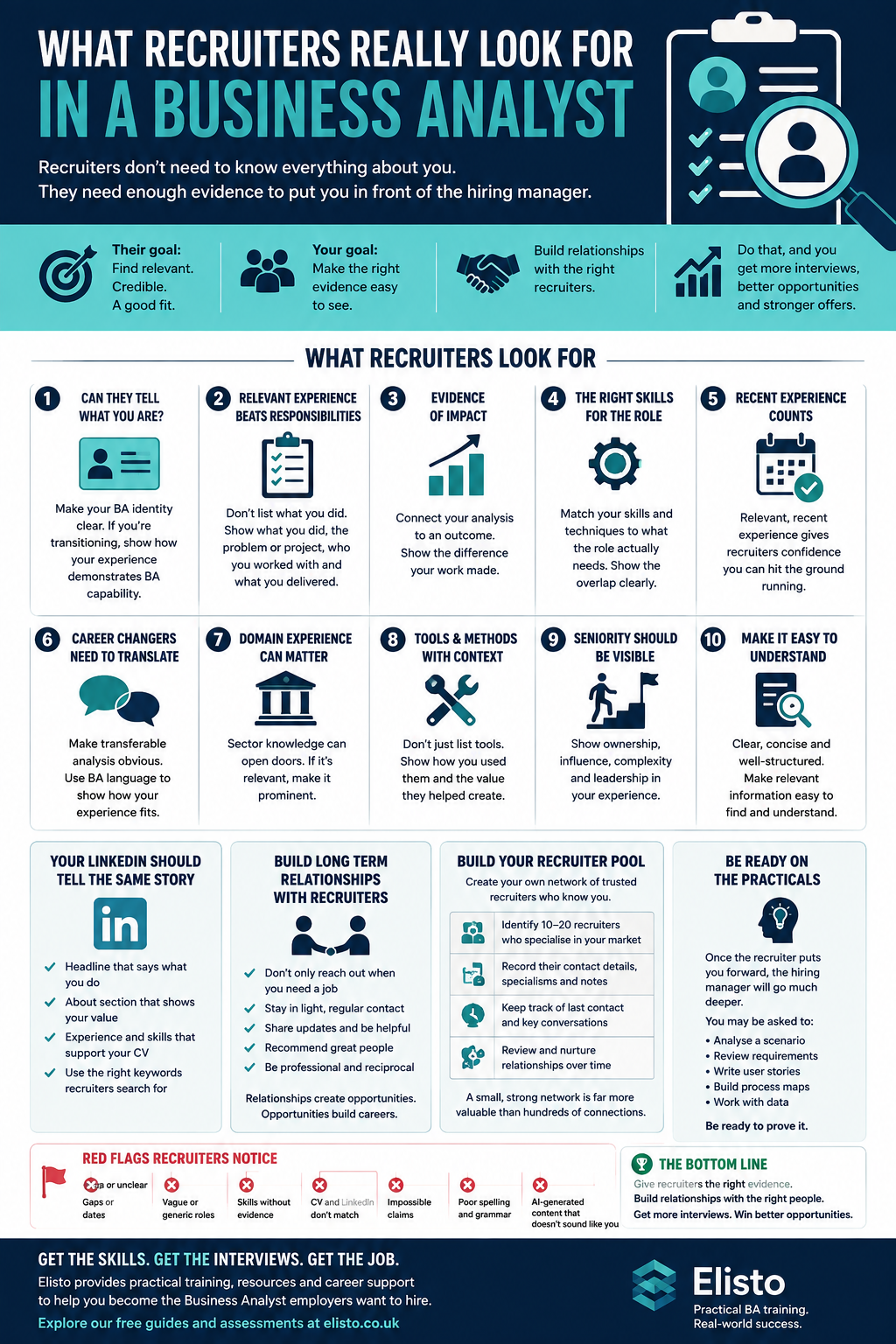
1. Can they immediately tell what you are?
This sounds almost ridiculously basic but it isn't.
If you're applying for a Business Analyst role, a recruiter should not have to spend the first minute of your CV working out whether you're actually a Business Analyst.
This is particularly important for people moving into BA work from adjacent professions. You might currently be a Systems Analyst, Data Analyst, Project Coordinator, Product Owner, Operations Manager or something else entirely.
That does not automatically prevent you from securing a BA position. The National Careers Service itself recognises alternative titles such as Process Analyst and Business Systems Analyst, while describing BA work in terms of investigating business needs, analysing findings, recommending improvements and supporting change. (National Careers Service)
The problem occurs when your presentation leaves the recruiter to make the connection themselves.
What should you do?
Make your intended professional identity clear without falsifying your current or previous job titles.
Your opening profile should quickly establish what you do, your relevant experience, the environments in which you've worked, your strongest capabilities and the kinds of problems you've helped solve.
If you're transitioning into Business Analysis, explicitly connect your existing experience with BA capability.
Don't pretend you held a BA title if you didn't.
Instead, show that you have performed Business Analysis.
2. Relevant experience beats a list of responsibilities
Consider these two statements:
Responsible for gathering requirements and liaising with stakeholders.
And:
Led requirements discovery across Operations, Finance and Technology for the replacement of a manual customer-onboarding process, translating business needs into prioritised requirements for the delivery team.
Both describe BA activity. I "know" it's written heavily in what I'm patenting as "LinkedInglish" but it does tell a valid story.
Only one tells the reader much about the candidate.
Current specialist BA recruitment advice makes exactly this distinction: job titles alone can hide enormous differences in capability, so employers need to understand what candidates delivered, what problems they solved and how they worked with stakeholders. (Bristow Holland)
A recruiter doesn't need another definition of what a Business Analyst does.
They need evidence of what you did.
What should you do?
Go through every significant role on your CV (and you're LinkedIn profile) and ask:
What was happening? What project, product, change or business problem were you working on?
What did I personally do? Not what the team did. What did you investigate, analyse, facilitate, define or recommend?
Who did I work with? Users, SMEs, developers, Product Owners, architects, senior leadership, Operations?
What did my analysis produce? Requirements, process models, options, user stories, recommendations, business rules?
What happened because of it?
That final question is particularly important.
3. Recruiters want evidence of impact
Business Analysis CVs can easily become catalogues of activity:
Gathered requirements.
Facilitated workshops.
Wrote user stories.
Created process maps.
Supported UAT.
Those things might all be true. The problem is that they describe what you were busy doing, rather than the value you provided.
A stronger CV connects activity with an outcome.
Perhaps your process analysis identified an unnecessary manual stage. Better requirements reduced rework. Discovery prevented the organisation from buying the wrong solution. Analysis identified why customers were abandoning a service. Your work helped a team release a new digital journey.
The outcome does not always need a dramatic percentage or monetary figure. Don't invent metrics because somebody told you every CV bullet needs a number.
But where a genuine outcome exists, use it.
What should you do?
Instead of:
Facilitated stakeholder workshops to gather requirements.
Consider:
Facilitated discovery workshops across Customer Services, Operations and Technology, resolving conflicting requirements and establishing an agreed scope for the new customer portal.Then be ready to defend/explain this if necessary.
The second tells the recruiter considerably more about your capability.
4. Can they see actual Business Analysis capability?
The exact techniques required vary considerably between roles.
A process-heavy BA vacancy may care deeply about process modelling. A digital Agile role might focus on user needs, user stories, acceptance criteria, backlog refinement and multidisciplinary delivery. A data-heavy position might require Excel, SQL, Power BI or stronger quantitative analysis. Transformation work may emphasise operating models, stakeholders and complex organisational change.
That's why generic CVs struggle.
The recruiter isn't asking:
“Does this person know Business Analysis?”
They are asking:
“Does this person's Business Analysis experience match this vacancy?”
What should you do?
Read the job description before tailoring your CV.
Identify perhaps the six to ten genuinely important capabilities the employer appears to need.
Then find evidence for them in your actual experience.
If they want:
process mapping + stakeholder workshops + requirements elicitation + user stories + UAT + Agile delivery
your CV should make genuine experience in those areas visible.
Don't copy the job advert wholesale. Don't add skills you don't possess.
Make the overlap between what they need and what you have done obvious.
5. Recent experience matters
Imagine you spent five years as a Business Analyst and then the next six as a Project Manager. You now apply for a Senior BA vacancy.
You may possess substantial BA experience, but a recruiter can reasonably ask:
How current is it?
The same applies to particular tools, domains and delivery environments.
Claiming extensive Agile experience because you worked in Scrum teams several years ago is different from having spent the last three years embedded in Agile product delivery.
What should you do?
Give recent and relevant work more space.
If an older role contains particularly valuable experience for the vacancy, retain enough detail to make it visible.
And if you've continued performing BA activities while holding another title, say so.
Don't force the recruiter to reconstruct your career to discover it.
6. Career changers need to translate their experience
This is one of the biggest missed opportunities for aspiring BAs.
Somebody working in Operations may already investigate problems, interview users, document processes, analyse data, identify inefficiencies, define business needs, work with technology teams, support testing and implement change.
Those are potentially valuable experiences.
But if the CV describes them entirely in the language of the old profession, a recruiter may never recognise them as evidence of Business Analysis.
What should you do?
Translate your genuine experience into language that makes its relevance clear.
For example:
Managed complaints.
might conceal:
Analysed recurring customer complaints to identify process failures, working with Operations and Technology to define improvements to the customer journey.
Same person. Same job.
Completely different evidence.
The objective isn't to disguise your previous career. It's to make the transferable analysis within it visible.
7. Domain experience can matter — sometimes enormously
A BA vacancy in retail ecommerce and a BA vacancy on a banking regulatory programme may share core analytical skills while requiring very different domain knowledge.
Employers sometimes need somebody who can arrive with an existing understanding of the environment.
Financial services may value banking, payments, insurance or regulatory experience. Government programmes may value public-sector delivery. Healthcare may require familiarity with NHS environments. Defence positions may require particular clearance.
Domain experience therefore isn't automatically a decorative extra.
Sometimes it's a filter.
What should you do?
If your domain experience matches the vacancy, make it prominent.
Don't bury ten years of financial-services experience halfway down page two when applying to a bank.
Equally, don't reject yourself merely because you haven't worked in a sector unless the requirement is genuinely essential.
Separate:
“The employer would prefer this.”
from:
“The employer cannot realistically hire without this.”
Those are different things.
8. Tools and methodologies matter — but don't build a keyword landfill
Jira. Confluence. BPMN. SQL. Excel. Visio. Agile. Scrum. Waterfall. UML. Power BI.
Putting all of those in a box doesn't make somebody an excellent Business Analyst.
However, tools and methodologies can matter when relevant to the vacancy, particularly because recruiters and recruitment systems need to identify particular experience.
The trick is providing context.
What should you do?
Don't just write:
Jira, Confluence, Agile, Scrum.
Where possible, let the experience demonstrate the capability:
Managed and refined user stories and acceptance criteria within Jira as part of a multidisciplinary Scrum team delivering a new digital service.
Now the tool has context.
The methodology has context.
And your BA capability has context.
9. Your seniority needs to be visible
A Senior Business Analyst should not merely look like a Business Analyst who has been doing the job for longer.
Seniority should appear in the nature of the work.
Greater ambiguity. Greater ownership. More difficult stakeholders. More complex programmes. Leadership of analysis. Influencing decisions. Coaching other analysts. Working across multiple teams. Shaping the analytical approach rather than simply following one.
If you're applying for senior positions but your CV repeatedly says:
Assisted with...
Supported...
Participated in...
you may be unintentionally presenting yourself below your actual level.
What should you do?
Ask where you owned something.
Where did you lead? Where did somebody rely on your judgement? Where did you challenge a proposed solution? Where did your analysis influence a significant decision? Where did you coordinate analysis across teams? Where did you mentor other BAs?
Make genuine seniority visible without exaggerating it.
10. Your CV has to be easy to understand
Recruiters are not archaeologists.
Don't make them excavate your suitability from six pages of dense prose.
A recruiter should be able to establish your broad fit quickly: professional identity, experience level, relevant domains, core capability and recent employment.
What should you do?
Look at your CV from the perspective of somebody who has never met you.
Can they identify from the opening section what you are, your approximate experience, your strongest BA capabilities, relevant sectors and the type of work you've been doing recently?
Then scan each role.
Can they understand the organisation, project or problem?
Can they see what you did?
Can they see why it mattered?
If not, rewrite it.
11. Your LinkedIn profile should support the same story
A recruiter who likes your CV may look you up. More importantly, recruiters can discover you on LinkedIn before you've applied for anything.
If the CV presents you as an experienced Business Analyst while LinkedIn tells a completely different professional story, you've introduced unnecessary doubt.
The two don't need to be identical. They serve different purposes.
But they should make sense together.
What should you do?
Check your headline, About section, experience, skills, dates and job titles.
Does your headline reflect the work for which you want to be found?
Does your About section make your experience and specialism clear?
Does your experience support your CV?
Are important BA skills represented?
Do the dates and titles broadly correspond?
Recruiter guidance in 2026 continues to emphasise a clear LinkedIn headline, appropriate skills and search terminology because recruiters use titles, skills, industries and locations to identify candidates. (careers.manpowergroup.co.uk)
Need help getting LinkedIn working harder?
Elisto's free guide, How to Get a Business Analyst Job Using LinkedIn, covers practical ways to improve your profile, increase your visibility and make it easier for recruiters and employers to understand what you offer.
12. Don't just contact recruiters when you need a job
This is where candidates can make a significant mistake.
They treat recruiters as a search engine.
When they need work, they contact 50 recruiters:
“Hi, I'm currently looking for my next opportunity. Please let me know if you have anything suitable.”
They secure a job.
Then disappear for two years.
When the contract or employment ends, they contact another 50.
There is a better approach.
Build a small network of recruiters who know who you are before you need them.
Current recruiter guidance explicitly recommends treating recruiter relationships as long-term rather than one-off transactions: keeping in touch after securing work, updating recruiters on progress and maintaining the relationship over time. (LinkedIn)
This becomes increasingly valuable as your career develops.
A recruiter who has spoken to you repeatedly over several years may understand your experience, reputation, rate, preferred industries, availability and the kind of work you will and won't accept.
You cease being another CV arriving in an inbox.
You become someone they know.
Build your own recruiter pool
You don't need hundreds.
Start by identifying perhaps 10–20 recruiters who genuinely operate in the market you want to work in.
For a Business Analyst, that might mean recruiters specialising in:
- Business Analysis and change
- digital transformation
- product and Agile delivery
- financial services
- government and public sector
- defence and national security
- healthcare
- permanent BA recruitment
- contract BA recruitment
Choose according to your actual career.
Then maintain a simple recruiter database.
A spreadsheet is perfectly adequate:
| Recruiter | Agency | Specialism | Email | Phone | LinkedIn | Last Contact | Relationship | Notes |
|---|---|---|---|---|---|---|---|
| Jane Smith | Example Recruitment | BA/Change | jane@... | 07... | LinkedIn | 12 Aug | Strong | Places senior contract BAs |
| John Jones | Example Talent | Defence | john@... | 07... | LinkedIn | 3 Jul | New | SC-cleared roles |
You could also record:
Typical roles | Locations | Permanent/Contract | Rate range | Clients/sectors | Last role discussed | Next contact
Now you're building an asset.
What should you do?
Don't send everybody the same generic LinkedIn message.
Introduce yourself properly.
Explain your experience, market and what you tend to look for. Have an actual conversation where possible. If they're a relevant recruiter, connect on LinkedIn.
Then stay lightly in touch.
Not every Tuesday.
Not with:
“Anything for me?”
every fortnight.
Instead, contact them when there is a reason. Although, if you’re a contractor and you’re actively looking for work, I think it makes sense to do this regularly. Work all the angles, not just LinkedIn.
You've started a significant new role.
You've completed a major programme.
Your contract is approaching its final few months.
Your availability has changed.
You've acquired clearance or particularly useful experience.
You can recommend somebody good for a vacancy they're trying to fill.
You see they've moved agencies.
You simply haven't spoken for several months and want to reconnect.
The relationship should be professional and reciprocal, rather than appearing only when you need something. Broader networking guidance similarly cautions against beginning relationship-building only at the moment you need help. (Business Insider)
And be useful.
If a trusted recruiter says:
“Jude, I'm desperately trying to find a Senior BA with payments experience. Know anybody?”
and you know somebody excellent, introduce them.
Recruiters remember people who help them solve problems.
Your recruiter network should move with your career
The recruiters useful to you when you're trying to secure your first £35,000 BA role may not be the same people you need when you're competing for £600-a-day transformation contracts ten years later.
Review your pool periodically.
Who is still active?
Who has changed market?
Who consistently brings relevant opportunities?
Who understands you?
Who wastes your time?
Who would you genuinely telephone tomorrow if your contract unexpectedly ended?
The aim isn't quite the case that you’re trying to collect recruiters.
It’s more that you’re trying to build a small professional network capable of producing opportunities throughout your career.
For contractors in particular, that's enormously valuable. You don't want your first action after discovering that your contract ends in four weeks to be:
“Right. I suppose I'd better find some recruiters.”
Build the network while you're working.
13. Practical details can eliminate you before capability is discussed
Sometimes rejection has very little to do with your BA ability.
The role requires three days a week in London and you will only work remotely.
It requires security clearance.
You have a three-month notice period and the client needs somebody in three weeks.
Your expected day rate is £650 and the maximum budget is £450.
The client requires particular working rights.
These are practical recruitment constraints.
What should you do?
Establish the fundamentals early.
For contract roles in particular, know your availability, target rate, acceptable locations, remote/hybrid expectations, clearance status where relevant and contract preferences.
Then ensure the recruiters in your pool understand them.
That saves everybody time.
14. Contractors are judged slightly differently
A permanent employer may be hiring somebody they expect to develop over several years.
A client paying a contractor hundreds of pounds per day often has a more immediate expectation:
How quickly can this person become useful?
A contractor's CV therefore benefits from demonstrating autonomy, adaptability and delivery.
Can you enter an unfamiliar organisation, understand a problem, establish relationships, create clarity and start producing useful analysis without requiring months of support?
That's part of what justifies the premium.
What should you do?
If you're pursuing BA contracting, make your CV commercially focused.
Show problems you were brought in to solve, difficult environments you entered, responsibility you assumed quickly, tangible outputs and outcomes, complex stakeholders and evidence that you can operate independently.
And don't simply take a permanent BA CV and replace “salary” with “day rate”.
Contract recruitment is its own market.
Elisto's How to Become a £500-a-Day BA Contractor explores the move into contracting in greater depth, including how to think about your experience, marketability and readiness for contract work.
Explore the £500-a-Day BA Contractor guide
15. Watch the red flags
Recruiters aren't only looking for reasons to progress you.
They're also noticing reasons not to.
Potential concerns include:
- dates that don't make sense
- significant contradictions between CV and LinkedIn
- claims that seem implausible
- vague descriptions of supposedly senior roles
- enormous lists of technologies without evidence of using them
- a CV clearly written for another profession
- poor spelling and grammar
- completely generic applications
- describing every role with identical BA terminology regardless of what actually happened
- being unable to explain something you claimed when the recruiter telephones.
There is another increasingly relevant risk: outsourcing so much of your application to AI that you no longer sound like yourself (who, me?).
AI can help structure, critique and improve an application but if it manufactures achievements, fills your CV with language you would never use or produces claims you cannot defend at interview, it has made your application worse.
What should you do?
Read every sentence and ask:
Could I comfortably explain and defend this if a hiring manager asked me about it tomorrow?
If the answer is no, it shouldn't be there.
The recruiter and hiring manager are looking for different depths of evidence
This distinction is worth remembering throughout your job search.
The recruiter is broadly trying to answer:
“Can I credibly put this person forward? (and not risk my relationship with my client!)”
The hiring manager ultimately needs to answer:
“Can this person solve the problems I need a Business Analyst to solve?”
Your CV, LinkedIn presence, recruiter network and recruiter conversations help get you across the first bridge.
They don't guarantee passage across the second.
Once you reach interview, employers can go considerably deeper. You may be asked to work through a case study, analyse a process, review requirements, write user stories and acceptance criteria on a shared screen, analyse data or explain how you would approach an unfamiliar business problem.
We've covered those methods separately in How Employers Assess Practical Business Analyst Capability.
At that point, you are no longer simply claiming that you can perform Business Analysis.
You may be asked to prove it.
So, what should you do before your next BA application?
Don't respond by rewriting your entire CV from scratch every time you see a vacancy.
Build a strong core CV and a repeatable process for adapting it.
Before applying, ask five questions:
1. What are they actually hiring this BA to do?
Forget the boilerplate. Identify the underlying problem, programme or capability they need.
2. What are the most important requirements?
Separate genuine essentials from the long list of desirable skills.
3. Where is my evidence?
For each important requirement, identify something you've actually done that demonstrates it.
4. Can a recruiter find that evidence quickly?
If your best example is hidden in paragraph six on page three, improve the presentation.
5. Could I defend every claim at interview?
If you can't explain it confidently, don't claim it.
Then think beyond the individual application.
Your career infrastructure should eventually look something like:
Strong core CV → credible LinkedIn profile → recruiter network → tailored application → recruiter conversation → interview → practical assessment → offer
And importantly, don't dismantle that infrastructure once you've found a job.
Keep your LinkedIn current.
Record significant achievements while you still remember them.
Maintain your recruiter pool.
Keep in occasional contact with the strongest recruiters.
Add good new recruiters you encounter.
Keep notes about who specialises in what.
If you're a contractor, start warming the network before the final weeks of an engagement rather than waiting until you're sitting on the bench.
That turns recruitment from something you desperately start doing when you need a job into something you manage throughout your career.
Don't ask whether your CV is “good”
Ask a better question:
“Does my CV give this recruiter enough relevant evidence to put me in front of this hiring manager?”
Then ask a second:
“Have I built the relationships that mean the right recruiters know I exist in the first place?”
A beautifully formatted CV that doesn't demonstrate relevance will struggle.
A long list of BA terminology won't compensate for vague experience.
A certification cannot substitute for evidence that you've applied the skills.
And holding the job title “Business Analyst” doesn't automatically prove that you've done the kind of Business Analysis this particular employer needs.
Your job is to remove doubt.
Make it obvious what you do. Make relevant experience easy to find. Show the problems you've worked on, the analysis you've performed and what changed because of it. Tailor that evidence to the vacancy.
Then build relationships with the people who take that evidence to employers.
Because the strongest position isn't necessarily having 500 recruiter connections on LinkedIn.
It's having a dozen good recruiters in your phone who know exactly who you are, what you're good at and when they should call you.

Turn recruiter interest into an interview — and (more importantly) an interview into an offer
Elisto provides practical Business Analyst training and career support for people trying to enter the profession, secure their next role, improve their practical capability or progress towards senior and contract positions.
Depending on where you are in your career, the next step might be:
- How to Get a Business Analyst Job Using LinkedIn — a free guide to improving your visibility and professional profile.
- The Real Business Analyst Career Path (UK) — a free guide to understanding where a BA career can take you.
- Business Analyst Career Transition Assessment — assess how convincingly your existing experience supports a move into Business Analysis.
- Business Analyst Contractor Readiness Assessment — explore how ready you are to compete for BA contract opportunities.
- How to Become a £500-a-Day BA Contractor — for experienced BAs considering the move into contracting.
- Elisto Business Analyst training and mentoring — practical, experience-led support for developing your capability and career.
And if you've already secured the interview, read How Employers Assess Practical Business Analyst Capability next.
Understanding what recruiters want helps you get into the room.
Building the right recruiter relationships helps you find more rooms to get into.
Being able to demonstrate your capability once you're there is what helps you get the job.
Share:
How employers assess practical BA capability
How to Position Yourself as a Business Analyst